
How Repurposing Old Content Uncovers The Value You Already Own
Picture the moment you finally hit publish on something you have been chipping away at for weeks. It might be an article, a short video, or a set of notes you have shared with a handful of subscribers. For a day or two it feels finished. Then Sunday evening arrives again, and you are staring at a blank page wondering what on earth you are supposed to write next.
That blank page is where a lot of people lose heart, especially if you are trying to build an online income in small pockets of time, without a team behind you and without wanting to spend every evening at a keyboard. The good news is that the piece you already wrote is very rarely finished working for you. It is usually still holding ideas you have not used yet.
Repurposing old content, done properly, means you are not constantly manufacturing something new from nothing. You are mining what you have already built, and asking AI to help you find what is hiding inside it.
The Trap Of Starting From Zero Every Week
Most of us were taught that content creation means sitting down and producing something fresh every time. A new article. A new post. A new idea, out of thin air, on schedule.
For anyone who does not want to spend all day chatting to people online, that is an exhausting way to run a small business. Working through hours of training videos just to keep up makes it worse.
It also wastes something valuable. One good piece of writing or one useful video usually contains far more than the single idea it was built around. A newsletter issue might hold three separate insights doing the job of one forgettable send.
One good piece of writing usually contains far more than the single idea it was built around.
The mistake is treating that piece as finished the moment it is published, rather than as raw material you have not fully used yet.
One Piece Of Content Is Not One Piece Of Content
Think about the last piece of work you wrote that people responded to well. It probably contained a statistic worth sharing on its own. Perhaps an example that could stand alone as a short story. Maybe three steps that would work perfectly as a simple checklist.
Buried inside most articles is a small warehouse of separate, usable ideas. The trouble is that we tend to read our own work as one finished thing rather than several smaller things stitched together. Most writers only ever mine the top layer of what they made.
Say you wrote a piece last month about staying consistent with your morning routine. Inside it might be one line about the single habit that changed everything for you. It might also hold a small story about a bad week you recovered from. Or a blunt opinion about why most advice on the subject misses the point. Each of those is a separate piece of repurposing old content waiting to happen, not a paragraph doing background work for a bigger idea.
Let AI Do The Digging, Not The Deciding
This is where AI earns its place, not as a replacement for your thinking. It is a way of putting AI to work for you without having to learn every technical detail yourself first.
The trick is in what you ask for. Do not ask AI to turn your article into ten social posts. That usually produces ten thin versions of the same sentence.
Instead, ask it to identify ten separate, interesting ideas, examples, or claims sitting inside the piece. That is a different job entirely. You are asking it to find material, not to rewrite your voice.
Once you have that list in front of you, the decisions become yours again. A surprising number becomes a short graphic. A personal example becomes an email. A firm opinion becomes a discussion post. A step becomes a short explainer you can send to your list next week.
Imagine your last piece of writing was about staying visible on social media without spending your whole week there. AI might turn up a line about posting less often but with more intention. It could also surface a short story about the week you nearly gave up on it. Or a blunt opinion about why chasing every platform is the wrong goal. Each of those can carry its own week, rather than sitting quietly inside one long article nobody quite finishes reading.
I have written before about building this kind of small, repeatable system rather than reinventing your week from scratch. I have covered a related angle on it in other articles I have shared recently, if you want to see how the pieces connect.
Where The Best Ideas Are Often Hiding
The part worth paying attention to is the material you were tempted to leave out the first time. A throwaway line. A single sentence you added almost as an afterthought. It rarely felt important enough to build a whole piece around at the time.
Ask AI one final, honest question about your best piece of work. What useful idea, contradiction, or follow-up question is hiding in it that you have not properly explored yet?
Some of the strongest ideas I have come across in my own writing were never the headline point. They were the small aside that deserved a whole piece of their own, and I only noticed once something else went looking for it.
This matters more for those of us building an income later in life than it might for someone twenty years younger with hours to spare. If you are working in small time blocks, around a market stall, a family, or simply a slower pace than you once kept, that matters. Getting more from the work you have already done is not a shortcut. It is the sensible way to build something that lasts without burning yourself out trying to keep up.
A Small Weekly Habit Worth Building
You do not need a complicated system to start. Pick one article, video, or set of notes you are proud of. Ask AI to mine it for ten separate ideas rather than summarise it.
Then choose two or three of those ideas and give each one its own small home. That home might be an email, a short post, or a simple follow-up piece. This is repurposing old content at its simplest, and it is worth building into a weekly habit.
Six months of doing this consistently will leave you with a small library of short pieces. They are built from work you have already done, rather than work you still have to invent. That is the quiet advantage of treating your own back catalogue as raw material for repurposing old content, rather than starting again each week.
Do that once a week and you stop staring at a blank page wondering what to say next.
You start asking a better question instead: have I really got everything I can out of what I already wrote?
That is a far kinder way to build an online income than trying to invent something new every single time you sit down.
There is real satisfaction in discovering that the work is not behind you after all.
It is still there, waiting for you to look at it properly. That is a good thing to remember whenever the blank page starts to feel discouraging.
Kind regards
Angus
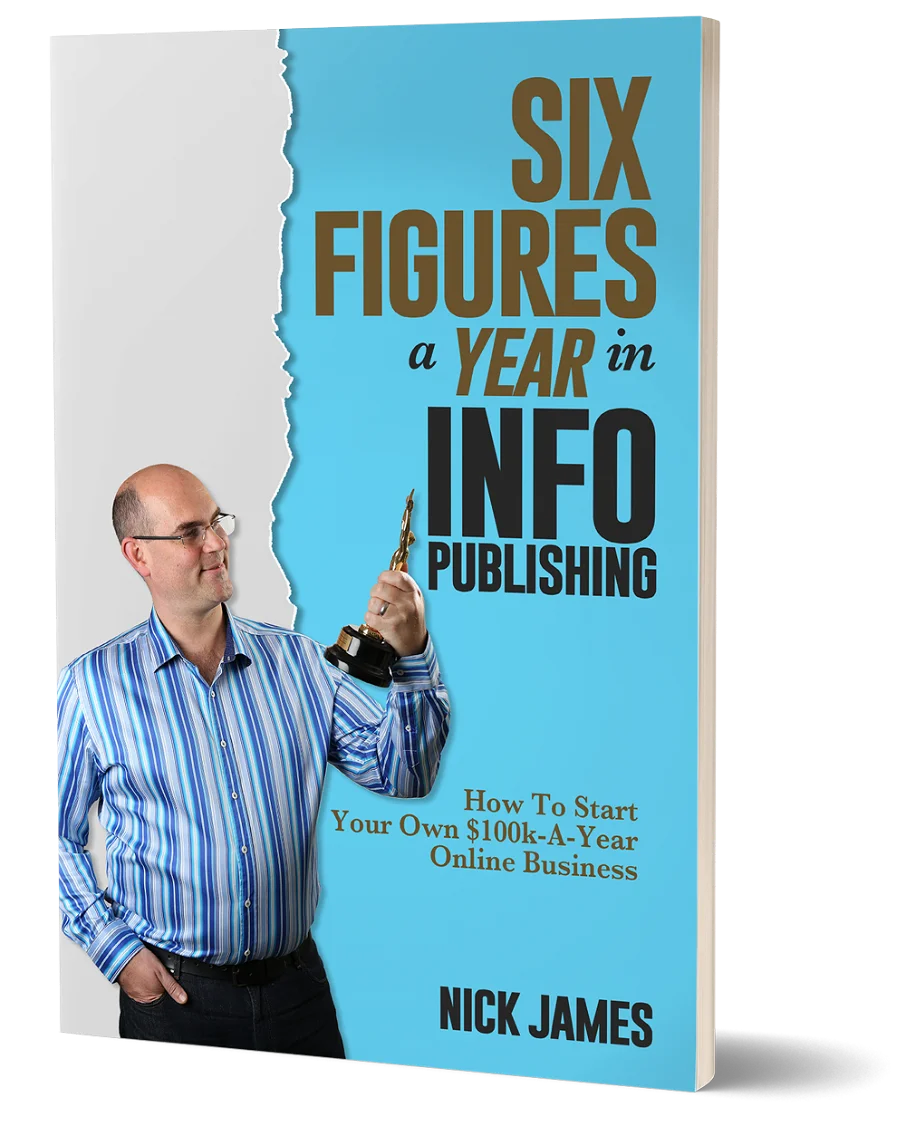
Author offers a FREE copy of this book to his next door neighbor... to prove he's not a drug dealer!
Now claim your FREE COPY.
and follow the step-by-step instructions for making the kind of money (and living the kind of lifestyle) that'll get your neighbors curtains twitching with curiosity!
Enter your details below to discover how to claim your FREE COPY of 'Six Figures A Year In Info Publishing' ...
Privacy Policy : We value your privacy. You can unsubscribe from receiving future emails with 1 click at any time.