
Confidence Won’t Sell Your Idea, But A Quick Reveal Will
There is a belief that keeps a lot of promising ideas trapped in a notebook. Or worse, built in full before anyone has had the chance to buy them. The belief goes something like this, that if an idea feels exciting enough at midnight, it must be worth building straight away. I would gently push back on that. The one habit that changes everything is learning to test your idea before you build a single page of it.
So many of the people I hear from have tried things in the past that failed. Not because the idea itself was poor, but because nobody checked, early on, whether buyers were already out there waiting for it. The good news is that this kind of checking takes minutes rather than months. It works whether you are seventy-one or twenty-seven, confident with technology or not in the slightest.
Before you spend another evening building anything new, you can find out whether people are already paying for something close to your idea. Real evidence beats hope every time. That is what I want to walk through today.
Why A Good Idea Still Needs Proof
Your idea can solve a genuine problem. It can come from years of real experience, your own or somebody else’s. None of that tells you whether a stranger will actually hand over money for the fix. Learning to test your idea early beats any amount of midnight confidence.
Confidence feels wonderful at midnight and rather wobbly by breakfast.
Proof is the thing that survives breakfast. It was left behind by people who tested a version of it without even meaning to.
Your job is simply to go and look, before a single hour is spent building. Do this before a single penny is spent on tools you may not need yet.
The Quiet Way To See What People Already Buy
Search your general topic on a marketplace such as Amazon, then sort the results by bestseller rank. If several similar products already sit near the top, real buyers are already spending real money in that space, today, not five years ago.
You are not copying anyone by doing this. You are simply confirming that hungry buyers exist before you build so much as a single page of your own.
Say your idea involves helping people downsize sensibly in retirement. A quick search on Amazon for decluttering guides or moving checklists will show you instantly whether that shelf is already crowded with buyers spending money, which tells you plenty before you write a single word of your own guide.
The same pattern shows up on course platforms and on marketplaces like Etsy. A crowd of similar offerings there is not a warning sign at all. A crowded shelf tells you that real people keep paying for help in that exact corner, year after year, long before you arrived.
I keep a short list of what I notice this way, much as I do with other articles I have shared recently. Small patterns like this tend to sharpen the next idea rather than the current one.
Where The Advertising Money Already Points
Businesses do not keep paying to advertise something that loses money. If the same type of offer keeps reappearing in your social feed, or in the newsletters you already read, somebody is making money from it. That is reason enough to justify them paying for the privilege.
That is buyer demand you can see with your own eyes, at no cost to you whatsoever, and no survey or focus group required.
Worth two further minutes, while you are at it, are the free communities where your own future readers already gather. A question that keeps repeating, in different words, from different people, inside a Facebook group or forum, is a demand signal. It is almost impossible to fake.
None of this needs a technical background. It needs a web browser, a cup of tea, and fifteen honest minutes.
Turning Proof Into Your Own Angle
Once you have found proof that a category genuinely sells, resist the urge to simply copy what you found. Bring your own angle to it instead.
Perhaps you serve a narrower reader than the bestsellers do. Perhaps you can explain one confusing step more plainly than anyone else currently manages for people your own age. Many of them are wary of being taken advantage of online, rather than trusting of a younger audience entirely.
If the bestsellers all speak to a younger, more casual buyer, your angle might simply be to write calmly and plainly for someone who has seen enough sales pitches to be wary of another one.
A specific idea, built for one clearly defined reader, tends to outsell a general one. Add proof that the wider category already sells, and you get the confidence to start today. That beats waiting for a certainty that never quite arrives.
Write your narrow angle down in one plain sentence before you move any further. If you cannot say who it serves, and what it gives them, in fewer than twenty words, the angle still needs a little sharpening.
What This Simple Check Saves You
Skipping this check is how an idea quietly turns into three wasted months spent building something nobody particularly wanted. Running the check first means that every hour you give it afterwards goes toward something with a real market already standing behind it. This is exactly why learning to test your idea before you build anything matters so much right now.
If you sink forty hours into something nobody wants, that time is gone from your week for good. At our stage of life, that time matters rather more than it once did.
Ten minutes of checking protects every one of those hours before they quietly disappear into the wrong project.
I have watched this exact mistake cost people far more than money; it cost them momentum, the thing hardest to rebuild once confidence has taken a knock.
You get to build with confidence instead of hope, and that confidence changes how you show up. You stop second-guessing every sentence, and you move from planning into actually finishing, which is the one step most people never quite reach.
Pick the one idea sitting in your notes right now. Give it fifteen minutes on a marketplace of your choosing, and a quick look at what is already being advertised in that same space. Write down exactly what you find.
If the evidence is there, you now have genuine permission to build with confidence. If it is not there yet, you have saved yourself months chasing a market that was never going to show up in the first place.
Either way, you win, and the idea you test next will be sharper for it.
Kind regards,
Angus Fraser
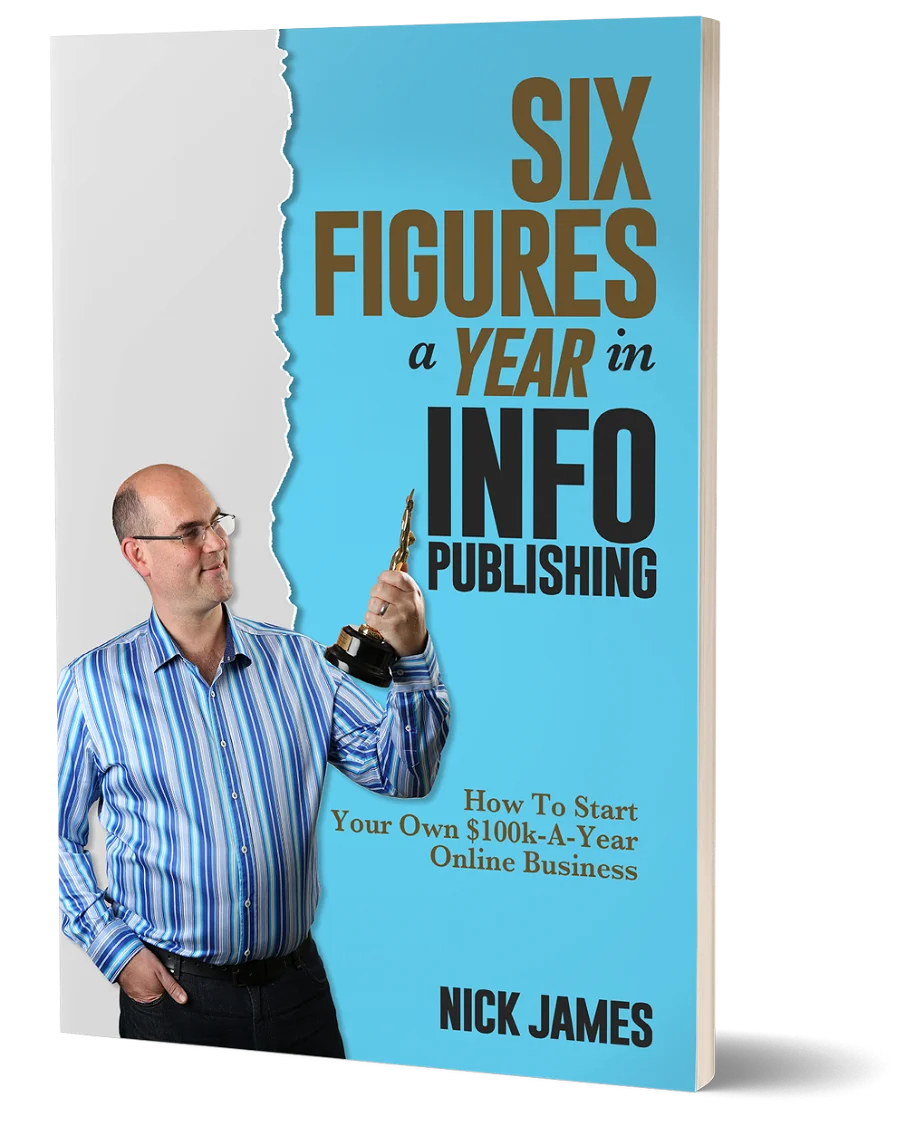
Author offers a FREE copy of this book to his next door neighbor... to prove he's not a drug dealer!
Now claim your FREE COPY.
and follow the step-by-step instructions for making the kind of money (and living the kind of lifestyle) that'll get your neighbors curtains twitching with curiosity!
Enter your details below to discover how to claim your FREE COPY of 'Six Figures A Year In Info Publishing' ...
Privacy Policy : We value your privacy. You can unsubscribe from receiving future emails with 1 click at any time.